
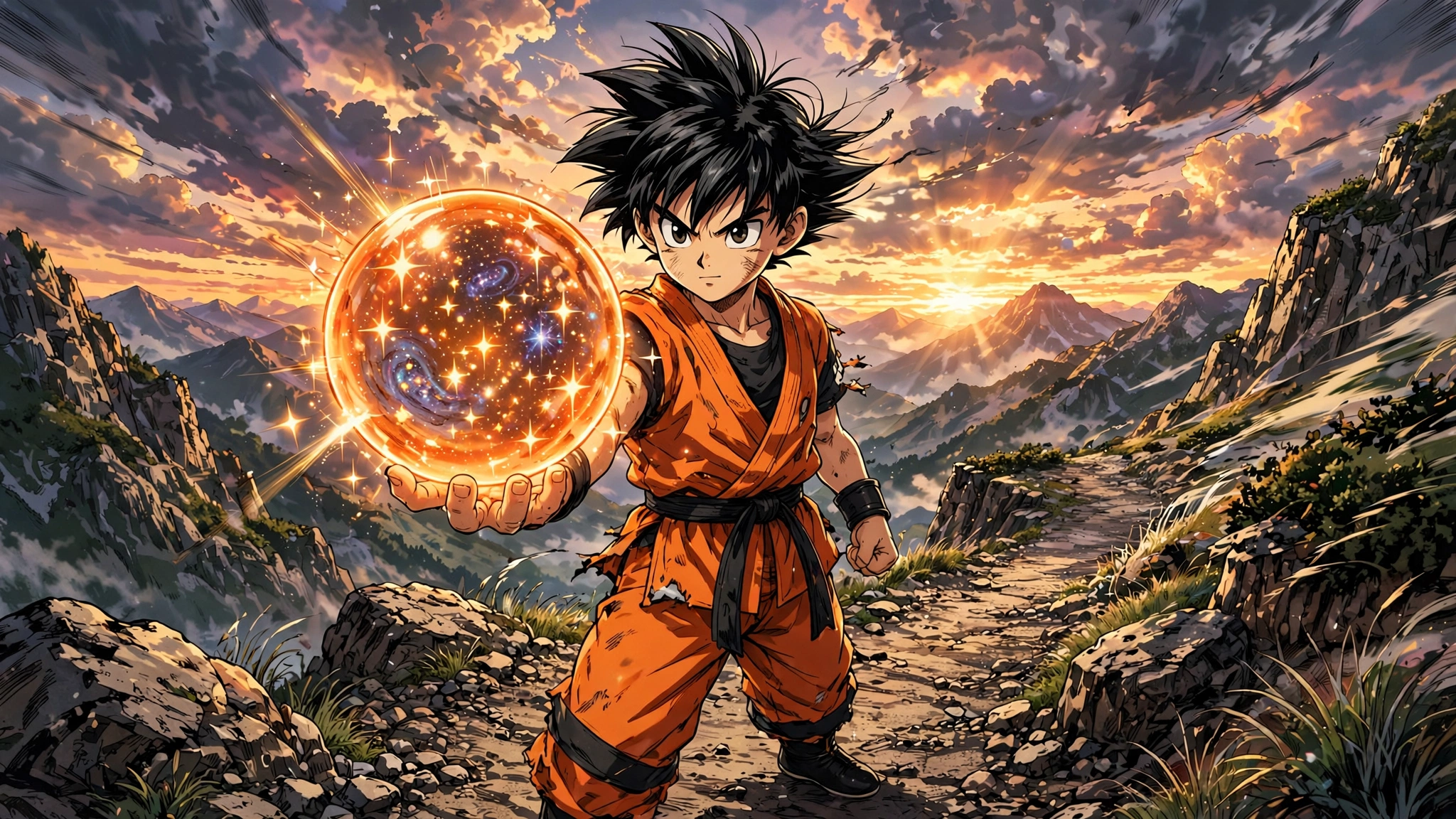
Dragon Ball Books in Order is one of the simplest reading orders in manga, once you understand one quirk: in English, the series was split into two different titles. Akira Toriyama’s original manga is a single story of 42 volumes and 519 chapters, serialized in Weekly Shonen Jump from November 1984 to May 1995. In Japan it was always just Dragon Ball. In the West, VIZ Media published volumes 1-16 as Dragon Ball and volumes 17-42 as Dragon Ball Z. They are the same story, and you read them straight through, volume 1 to volume 42, with no skipping and no alternate route.
That split causes most of the confusion new readers run into. Bookshops shelve the two halves separately, box sets come in two pieces, and the anime’s two titles make it look like two different series. It is not. Goku’s story runs in one continuous line from the day he meets Bulma in the mountains to the final tournament at the end of the series. This guide maps every saga to its volumes, explains the editions, and tells you where Dragon Ball Super fits after the original ends.
Dragon Ball Books in Order: Every Saga by Volume
The original 42 volumes break into nine sagas. The first 16 volumes carry the Dragon Ball branding in English, and volumes 17-42 carry the Dragon Ball Z branding:
- Emperor Pilaf Saga (volumes 1-2): Goku, a boy with a monkey tail and impossible strength, meets Bulma, and the two set out to find the seven Dragon Balls. The tone is pure adventure comedy, and the series’ whole cast is introduced here.
- Tournament Saga (volumes 2-4): Goku trains under Master Roshi and enters the World Martial Arts Tournament. The fights get serious, and the series finds the tournament formula it would return to again and again.
- Red Ribbon Army Saga (volumes 5-9): Goku takes on the Red Ribbon Army alone, hunting the Dragon Balls one base at a time. The scope widens from tournaments to a world-spanning conflict.
- Fortuneteller Baba and Tien Shinhan Sagas (volumes 9-12): A tournament rematch with old rivals, new enemies in Tien Shinhan and Chiaotzu, and the first hints that the series is about to get darker.
- King Piccolo Saga (volumes 12-14): The Demon King Piccolo kills Krillin and threatens the world. Goku’s first real loss and his first real revenge story, and the moment the series turns from adventure into high-stakes action.
- Piccolo Jr. Saga (volumes 14-16): Goku, now grown up, faces Piccolo’s son in the final tournament of the original run. This is where the English Dragon Ball branding ends.
- Saiyan Saga (Dragon Ball Z volumes 1-5): Goku learns he is a Saiyan, an alien warrior, and the series goes cosmic. Raditz arrives, Goku dies, and the fight with Vegeta and Nappa sets the scale for everything after.
- Frieza Saga (Dragon Ball Z volumes 6-12): The battle on Namek, the hunt for the Namekian Dragon Balls, and Goku’s first Super Saiyan transformation against Frieza. For many readers, this is the peak of the series.
- Cell Saga (Dragon Ball Z volumes 13-18): Androids, time travel, and the android Cell, who absorbs his way to perfection. Gohan takes the spotlight in the final battle.
- Buu Saga (Dragon Ball Z volumes 19-26): The final arc. The ancient Majin Buu is unleashed, fusions and new transformations pile up, and the series ends with a tournament and a passing of the torch.
Which Edition Should You Buy?
VIZ Media sells the original manga three ways, and the right choice depends on your budget and shelf space:
- Individual volumes: All 42 volumes are available in English, split as Dragon Ball volumes 1-16 and Dragon Ball Z volumes 1-26. Buy them in numbered order and you cannot go wrong.
- Box sets: Two box sets cover the whole series. The Dragon Ball Complete Box Set holds volumes 1-16, and the Dragon Ball Z Complete Box Set holds volumes 1-26. They are the cheapest way to own the complete run, and they include extras.
- 3-in-1 editions: VIZ released a 3-in-1 edition in 14 volumes between 2013 and 2016, using the Japanese kanzenban covers. This is the only English edition that presents the whole series under the single Dragon Ball name, and it is the best value per page if you prefer chunky omnibus volumes.
Where Does Dragon Ball Super Fit?
Dragon Ball Super is the sequel series, written by Akira Toriyama with art by Toyotarou, and it began in V Jump in 2015. Read it after volume 42 of the original, since it continues the story after the Buu Saga. As of 2026, Super has 24 volumes and 104 chapters in English, and it has been on hiatus since 2024, with chapter 104 arriving in February 2025 as a special one-shot. It is a separate purchase from the original 42 volumes, and there is no VIZ box set for it yet.
Two other Toriyama works connect to the series and are worth reading once you finish the main run. Jaco the Galactic Patrolman, a 2013 one-shot, is revealed in its final chapter to be set before Dragon Ball, and it introduces characters who later appear in Super. Dragon Ball SD is a light, chibi-style retelling aimed at younger readers, and it is entirely optional.
Do You Need to Read Dragon Ball Before Watching the Anime?
No, but the manga is the fastest way through the story. The original anime adapts the first 194 chapters, and Dragon Ball Z adapts the remaining 325, but both add filler episodes the manga never had. The manga has no filler, Toriyama’s art is at its best in the fight scenes, and the whole 42-volume run is a quicker read than the combined anime’s 500-plus episodes. If you grew up on the anime and want to see what you missed, the manga’s tournament and Piccolo arcs are where the differences are most obvious.
The bottom line is simple: read volumes 1 through 42 in order, then move on to Dragon Ball Super if you want more. There is no alternate timeline, no required side series, and no reading-order debate. It is one story, 519 chapters, and it is still the template every shonen manga since has been measured against.

Leave a Reply