
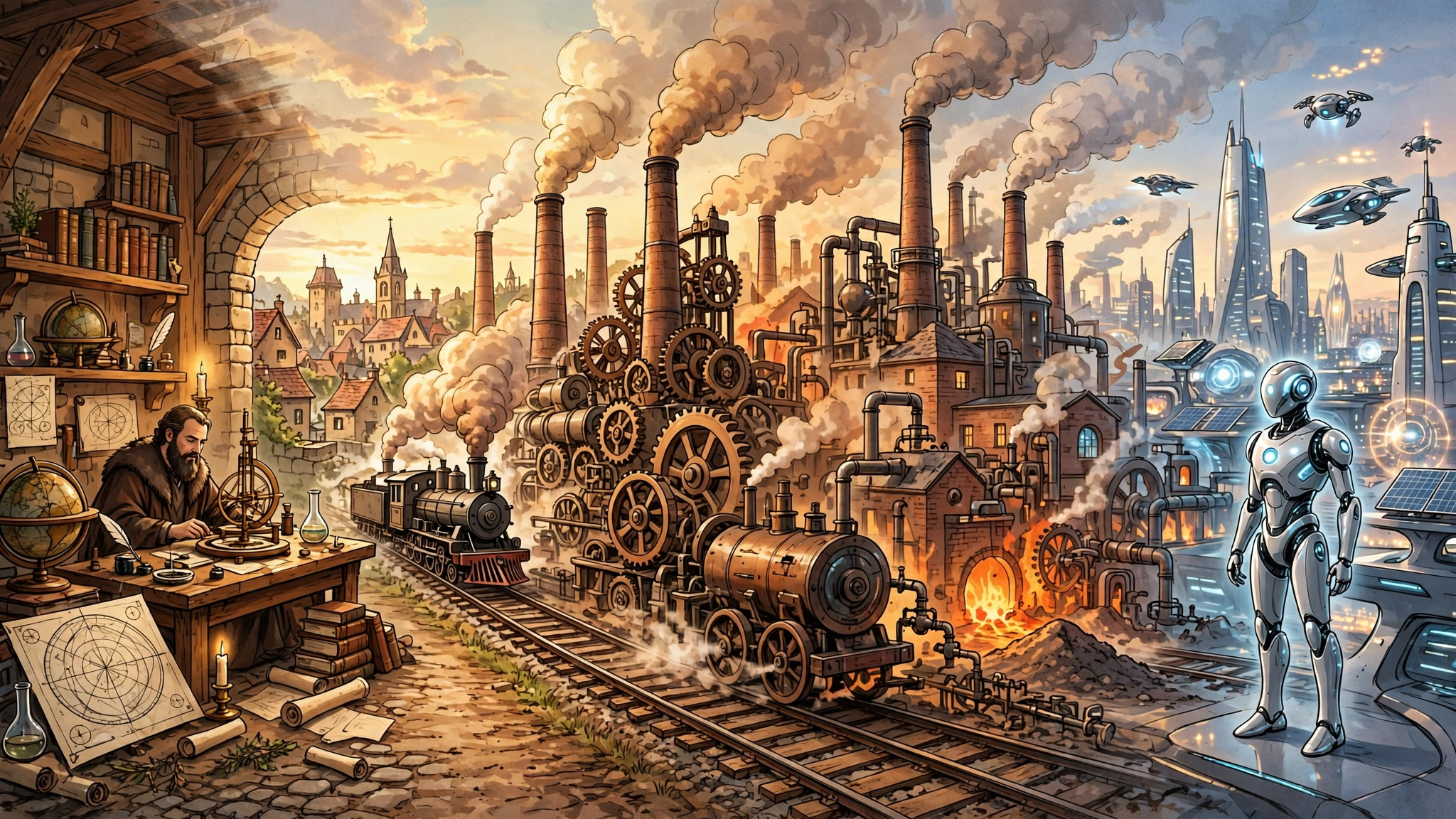
Sapiens A Graphic History Volume 4 arrives on November 3, 2026, and it closes one of the most ambitious adaptations in modern comics. Published by Harper Perennial as a 256-page paperback, The Age of Revolutions is the fourth and final installment of the graphic version of Yuval Noah Harari’s global bestseller Sapiens. Where the earlier volumes followed the Cognitive, Agricultural and political revolutions, this one asks how humanity got from the world of 1500 to the world of artificial intelligence — and what that journey might mean for what we become next.
Bookshops list the volume for November 3, 2026, and it also appears on comic-shop new-release lists for the week of November 4, 2026. That split is worth knowing if you are hunting for a copy: the book-trade date is November 3, while some comic shops receive their stock for the Wednesday shelf. Either way, this is the finale, so readers who have followed the series from the beginning finally get its closing argument.
Sapiens A Graphic History Volume 4: What It Covers
According to the publisher’s description, Sapiens A Graphic History Volume 4 grafts onto Part 4 of the original Sapiens book. It follows the revolutions that made modern humanity what it is today, taking readers from the sixteenth century through to the present day and beyond. The spine of the book is a simple, startling claim: until around 1500, human progress in medicine, military power and economics had reached something of a plateau, and then science changed the rules.
In the sixteenth century, the book argues, science overtook religion and philosophy as the dominant way of understanding the world. That shift did not stay in the laboratory. It fuelled imperialism and colonialism, powered the Industrial Revolution, unravelled old social and political structures, and ushered in modern capitalism. The graphic format suits that sweep: a single spread can move from a philosopher’s study to a factory floor to a trading port, showing how ideas, money and machines reinforced each other.
From the Scientific Revolution to the AI Revolution
The volume’s subtitle, The Age of Revolutions, is plural for a reason. Harari’s account does not treat the Scientific Revolution as one event, but as the start of a chain. The scientific way of thinking — test, observe, admit ignorance, try again — gave societies new tools, and those tools gave empires, industries and markets new reach. The book follows that chain through the Industrial Revolution, when rapid advances transformed society and reshaped capitalism, and on into our own technological age.
That is where the volume becomes most pointed. The publisher’s summary says the book takes readers to the dawn of the AI Revolution, asking how breakthroughs like artificial intelligence might transform human consciousness and the future of our species. It is a fitting final question for a series that began with the Cognitive Revolution: if shared stories and scientific thinking made us the dominant species on the planet, what happens when the thinking itself is partly handed to machines?
Why the Graphic Format Works for Sapiens
Sapiens in prose is famous for big ideas delivered in short, provocative chapters. The graphic adaptation keeps that pace but adds something prose cannot: visual jokes, diagrams, maps and recurring characters who argue with Harari himself on the page. Readers who found the original book dense, or who simply prefer to learn visually, often find the graphic volumes an easier way in — and a surprisingly faithful one, since the adaptation follows the book’s structure rather than inventing a new story.
Volume 4 benefits from that approach more than most. Revolutions are abstract, and a chart showing how scientific knowledge compounds, or a sequence showing how a new idea travels from a university to a battlefield, makes the argument concrete in a way paragraphs alone sometimes do not.
Sapiens A Graphic History Books in Order
If you are new to the series, read the four graphic volumes in order:
- Volume 1: The Birth of Humankind — the Cognitive Revolution and how Homo sapiens came to dominate the planet.
- Volume 2: The Pillars of Civilization — the Agricultural Revolution, and why farming made work harder and societies less equal.
- Volume 3: The Masters of History — who really drives history: kings and conquerors, bureaucrats and bankers, or the stories societies tell.
- Volume 4: The Age of Revolutions — the Scientific and Industrial Revolutions through to artificial intelligence.
You can read Volume 4 on its own if you already know the broad Sapiens argument, but the finale lands harder if you have seen the earlier revolutions build. Each volume is self-contained enough to follow, and the series as a whole works as a visual history of humanity in four books.
Who Should Read Volume 4?
This is a book for readers who like big-picture history, science writing and graphic non-fiction. It suits older teenagers and adults, particularly anyone who enjoyed the prose Sapiens, Homo Deus or Harari’s children’s history work, and anyone teaching or studying the Scientific and Industrial Revolutions who wants a visual companion. It is not a textbook, and it does not pretend to be neutral: Harari’s arguments about capitalism, empire and technology are provocative by design, and the book invites readers to argue back.
It is also a strong gift book: at 256 pages and listed at $35.00 on comic-shop listings, it completes a set many readers have been collecting since the first graphic volume appeared.
Final Verdict
Sapiens A Graphic History Volume 4 closes the series by asking the question the whole project has been building toward: after revolutions in thought, farming, politics, science and industry, what will we become? The November 3, 2026 release date makes it one of the biggest non-fiction graphic novels of the autumn, and for readers who have followed Harari’s visual history of humanity, it is essential reading. Start with Volume 1 if you are new; pick up Volume 4 now if you have been waiting for the ending.



Leave a Reply